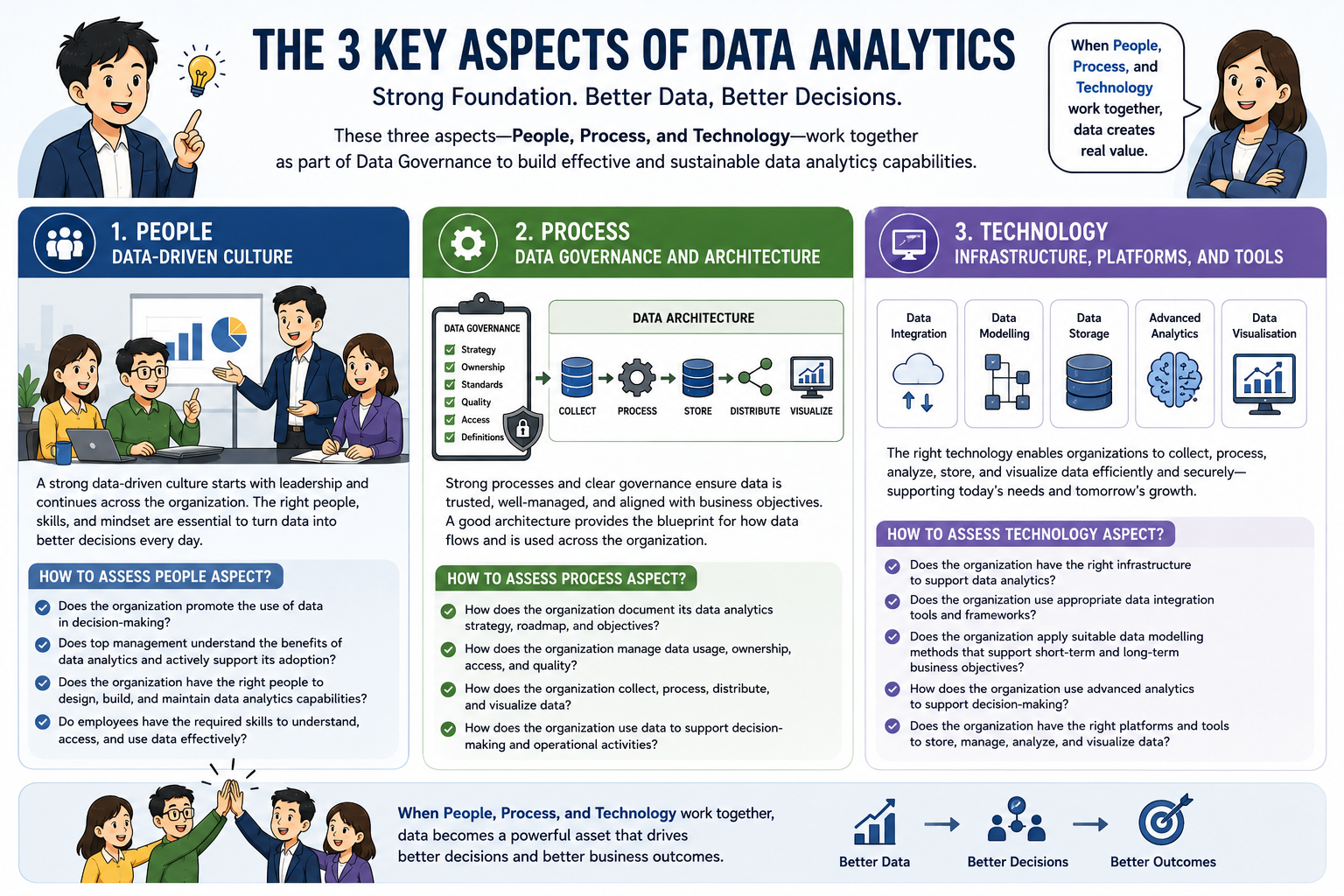
There are three key aspects organisations should consider when implementing data analytics: People, Process, and Technology. These aspects can be used as guidance to assess an organisation’s data analytics maturity and capability.
Together, they form an important part of Data Governance and provide the foundation for building sustainable, trusted, and effective data analytics capabilities.
People - Data-Driven Culture
A strong data-driven culture usually starts with leadership. Organisations that use data effectively often have support from senior management who understand the value of data and lead by example by making decisions based on evidence and insights.
A capable data team is also critical. The organisation needs people with strong analytical, technical, and business skills to design, build, and maintain data analytics capabilities.
At the same time, data-driven culture should not only belong to the data team. Employees across the organisation also play an important role. They need to be equipped with the right skills, tools, and confidence to use data in their daily decision-making and operational activities.
How to Assess the People Aspect
- Does the organisation promote the use of data in decision-making?
- Does senior management understand the benefits of data analytics and actively support its adoption?
- Does the organisation have the right people to design, build, and maintain data analytics capabilities?
- Do employees have the required skills to understand, access, and use data effectively?
Process - Data Governance and Architecture
Organisations with mature data analytics capabilities usually have clear Data Governance processes. Data Governance provides a structured way to document data strategy, ownership, standards, definitions, usage, access, and quality expectations.
It also helps organisations maintain data quality, manage who can access data, define how data should be used, and ensure that data is understood consistently across the business.
Data Governance should also include information about data architecture. Data architecture acts as the blueprint of the data environment and should align with the organisation’s objectives. It describes how data is collected, processed, stored, distributed, and visualised across the organisation.
How to Assess the Process Aspect
- How does the organisation document its data analytics strategy, roadmap, and objectives?
- How does the organisation manage data usage, ownership, access, and quality?
- How does the organisation collect, process, distribute, and visualise data?
- How does the organisation use data to support decision-making and operational activities?
Technology - Infrastructure, Platforms, and Tools
Data analytics technology refers to the infrastructure, platforms, tools, techniques, and methodologies that enable organisations to collect, process, store, analyse, distribute, and visualise data.
The technology components of data analytics should support the following capabilities:
- Data integration
- Data modelling
- Data storage
- Advanced analytics
- Data visualisation
The right technology should support both current and future business needs. It should be scalable, reliable, secure, and aligned with the organisation’s data strategy.
How to Assess the Technology Aspect
- Does the organisation have the right infrastructure to support data analytics?
- Does the organisation use appropriate data integration tools and frameworks?
- Does the organisation apply suitable data modelling methods that support both short-term and long-term business objectives?
- How does the organisation use advanced analytics to support decision-making?
- Does the organisation have the right platforms and tools to store, manage, analyse, and visualise data?