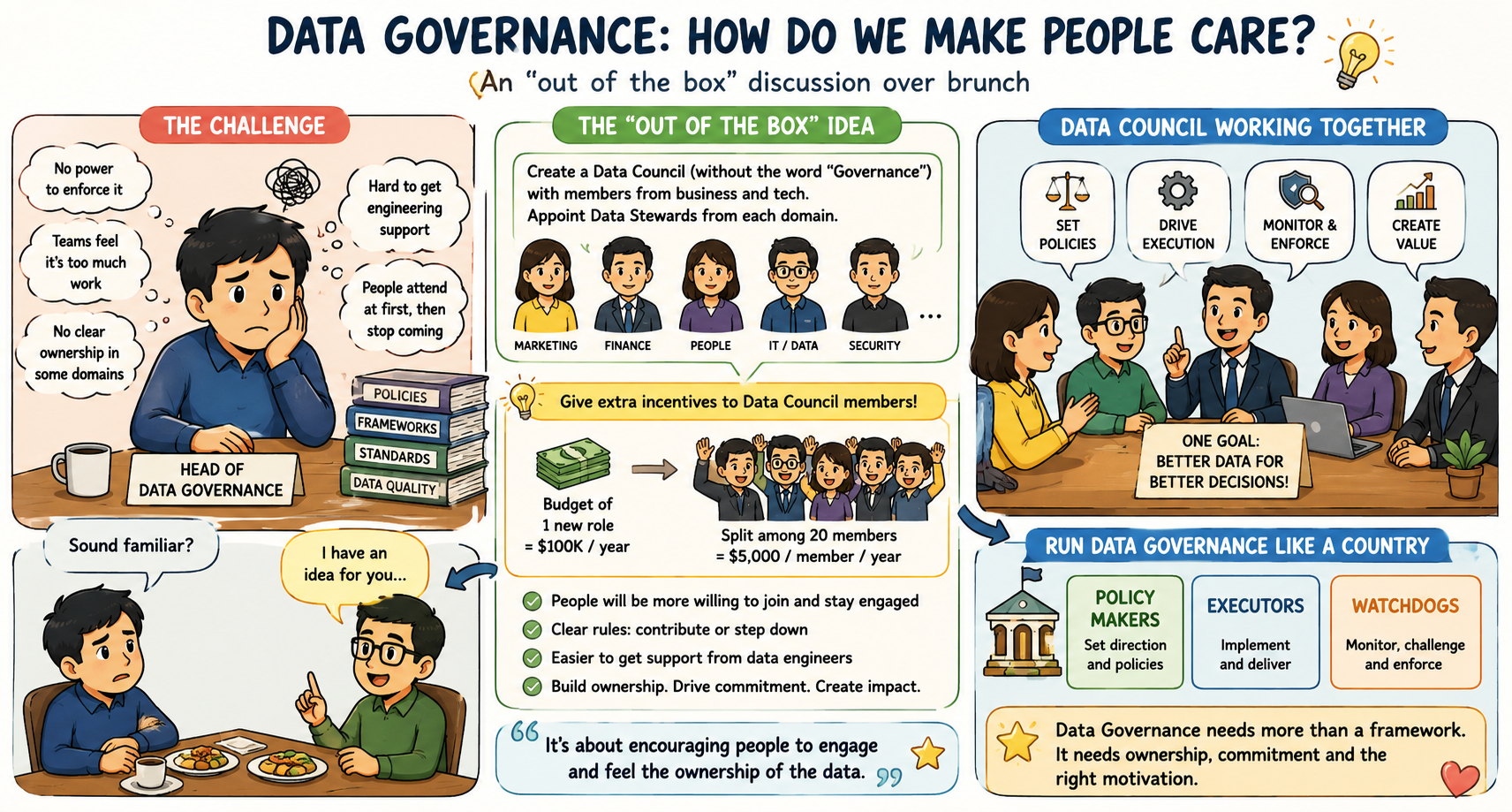
I caught up with some ex-colleagues. One of them is now Head of Data Governance at a well-known organisation. He shared his frustration with driving Data Governance initiatives. While his boss was supportive, he felt he had limited authority to make things happen. Other teams were hesitant to get involved, they saw governance as extra work, and ownership was unclear in some areas. He also found it difficult to get engineering support, especially for technical tasks such as extracting Power BI metadata and consolidating logs to support his data quality framework.
Engagement Challenge
He had already tried to form a Data Governance Council by appointing Data Owners and Data Stewards from different business units. I actually agreed with this approach. In many cases, Data Owners and Stewards are more effective when they come from the business itself, rather than being hired as separate roles. They understand the meaning, usage, and context of the data better than anyone else.
At first, the council looked promising. People attended the first few meetings and seemed engaged. But after a while, attendance started to drop. Some people stopped coming, and within a few weeks, almost half of the members were no longer consistently showing up.
Sound Familiar?
Data Council
I shared an idea with him: maybe we should run Data Governance more like running a country. First, I suggested removing the word “Governance” from the council name. The reason is simple. When we call it a “Data Governance Council,” people may see it as something owned by the Data Governance team. Instead, it should feel like an organisation-wide forum where business and technology teams jointly own data outcomes. The members should come from across the organisation, including data, digital, infrastructure, security, finance, marketing, people, and other key business domains. The goal is not just to discuss policies, but to make better decisions about data ownership, data quality, data usage, and data value.
How to Keep People Engaged
To help address the challenge of engagement, I also suggested that he discuss incentives with his boss. The idea came from how some government officers receive additional incentives when they take on extra responsibilities. Instead of hiring one or two additional people into the Data Governance team, why not use the budget of one role and distribute it across the Data Council members? For example, if one additional role costs around $100,000 per year, and the council has 20 members, each member could receive around $5,000 per year as an additional incentive.
Expectation
Of course, this should come with clear expectations. If a member does not attend, does not contribute, or does not support the agreed initiatives, then they should not continue receiving the incentive. They may need to step down and be replaced by someone who can actively contribute.
"Data Governance cannot survive on policies, frameworks, and documentation alone. It needs engagement, ownership, accountability, and commitment from across the organisation."
If we want people to contribute beyond their normal responsibilities, we need to recognise that contribution properly. Sometimes recognition can be visibility. Sometimes it can be career development. Sometimes it can be executive sponsorship. And in some cases, it may also be financial incentives.
Running Data Governance is a bit like running a country.
There needs to be a group that sets direction and policies. There needs to be a group that executes and delivers. There also needs to be a group that monitors, challenges, and enforces the rules. But most importantly, people need to feel that they are part of it. A Data Council should not be just another meeting in the calendar. It should be a forum where the organisation makes important decisions about data and creates real value from it.
To make Data Governance work, we need more than a framework. We need real ownership, commitment, and sometimes a different way of motivating people to care.