Since the AI boom, I have read many articles about how organisations should adopt AI. Many of them focus on tools, platforms, models, or data quality. While all of these are important, I believe organisations also need a simple way to structure their AI strategy. From my point of view, AI capabilities in an organisation can be grouped into three main pillars:
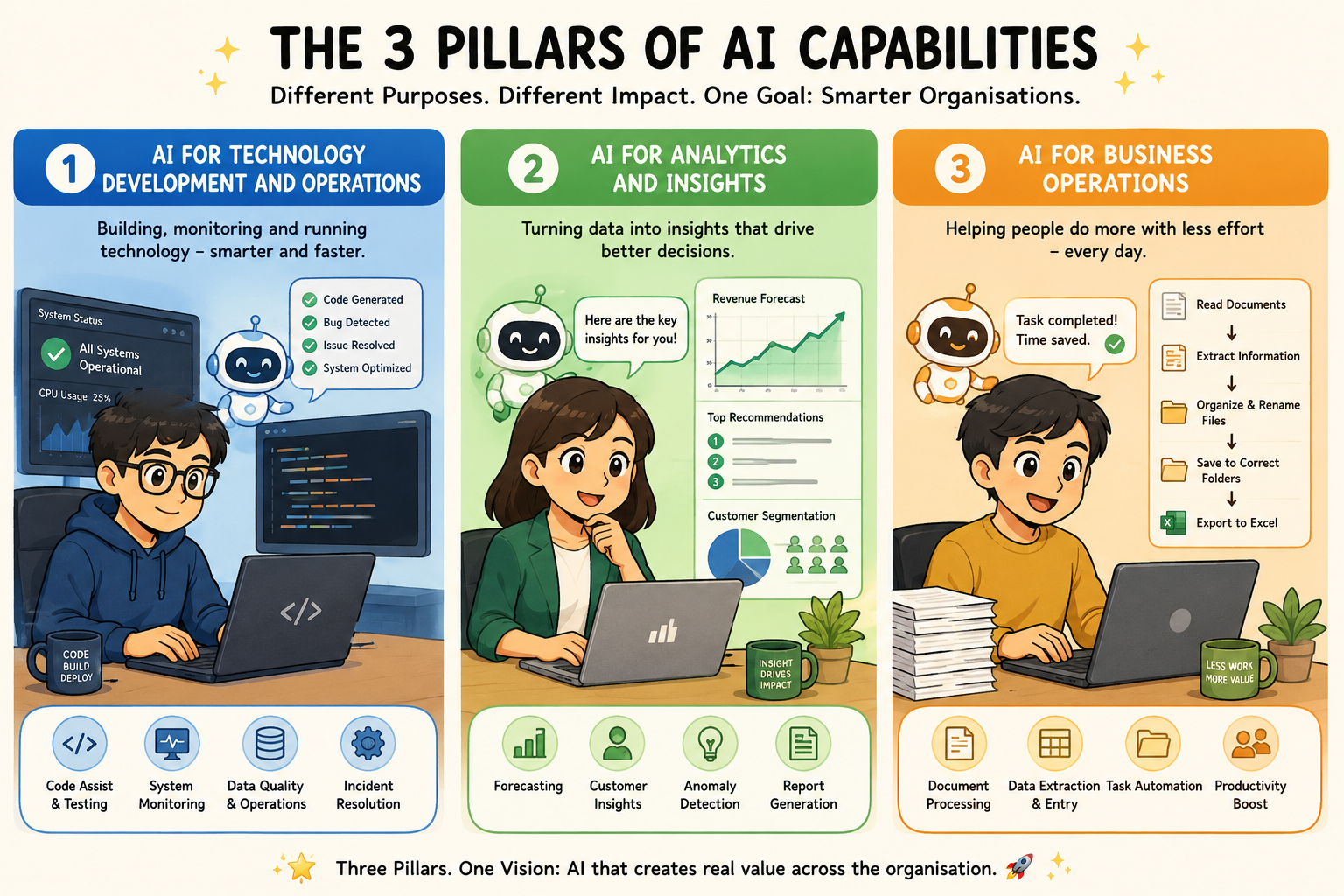
- AI for Technology Development and Operations
- AI for Analytics and Insights
- AI for Business Operations
1. AI for Technology Development and Operations
AI for Technology Development and Operations focuses on using AI to support system development, application delivery, IT monitoring, infrastructure management, and technology operations. This pillar can support developers, engineers, data teams, and IT operations teams in many ways. For example, AI can help developers write code, review code, generate test cases, document applications, detect bugs, and improve development productivity.
AI can also help technology teams monitor systems and infrastructure. Some AI tools can already be integrated with cloud services, monitoring platforms, and operational tools. The data used in this area usually comes from the technology environment itself, such as system logs, application logs, activity logs, performance metrics, alerts, and incident history.
For example, if a server often behaves abnormally, AI may be able to detect the pattern and recommend an action. In some cases, AI could even support automated remediation, such as restarting the server.
Of course, this should be designed carefully. Before restarting the server, AI may need to trigger other actions first, such as backing up the database, checking active processes, notifying the support team, or confirming whether the issue is safe to resolve automatically.
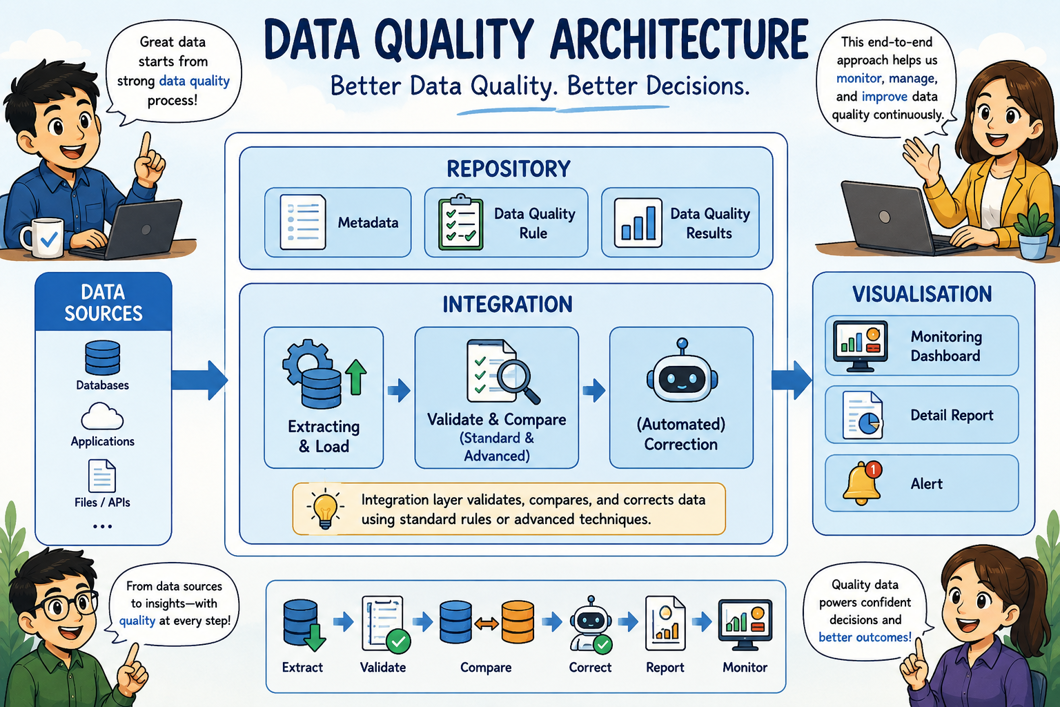
Another example is in data operations. AI can be used to support data quality checks and improvement. If data is often delayed, missing, or incomplete, AI can help compare the source system against the data that has landed in the data warehouse. If a recurring pattern is detected, AI may be able to recommend or trigger corrective action.
The value of this pillar is about improving technology delivery, reducing operational effort, increasing reliability, and helping technology teams become more efficient.
2. AI for Analytics and Insights
AI for Analytics and Insights focuses on using AI and machine learning to help organisations understand business performance, identify patterns, predict future outcomes, and support better decision-making. This is probably one of the most common areas people think about when they talk about AI in business. Examples include revenue forecasting, customer recommendations, customer segmentation, churn prediction, business performance insights, anomaly detection, and automated report generation.
This capability helps business leaders and teams get insights faster. Instead of only looking at what happened in the past, AI can help organisations understand what is likely to happen next and what actions they may need to take. For example, AI can be used to forecast revenue, recommend the right product or offer to customers, identify unusual business trends, or generate summaries from large volumes of data.
The value of this pillar is not only about producing reports faster. It is about helping the business make better and more timely decisions.
3. AI for Business Operations
AI for Business Operations focuses on helping people perform their daily activities more efficiently. This includes reducing manual effort, automating repetitive tasks, improving productivity, and allowing teams to focus on higher-value work. This is the area where I believe many organisations can start seeing practical value from AI very quickly. Let me share a simple example from my own experience.
I had a catch-up with my cousin, who owns an accounting and consulting company. He often shared how labour-intensive his business can be because many activities still require manual work. His clients often provide a large number of physical invoices. These invoices need to be scanned, reviewed, entered one by one into the journal ledger, and then archived digitally into specific folders based on client name and financial year. Then, I showed him live how AI could help his business.
I prepared a group of sample invoices and simulated the process he described. I placed the invoices into a folder and instructed AI to review the documents, rename the files based on company name and year, move them into the correct folders based on client and financial year, extract invoice details such as invoice number, date, supplier name, and total amount, and then put the results into an Excel spreadsheet.
He was amazed. He said, usually, this type of work would require several people and could take around one hour to process only 20 to 30 documents. The manual process may look something like this: The admin team scans the documents, which may take around 10 minutes. Then they rename the documents and move them into the correct folders, which may take another 30 minutes. After that, the accountant opens each invoice individually and enters the details into the journal, which may take another 20 to 30 minutes.
With AI, excluding the scanning process, the activity of renaming files, moving them into specific folders, extracting invoice details, and preparing the journal spreadsheet took around five minutes. In that simulation, the result was aligned with his expectations. This is only one simple example of how AI can boost productivity. It allows people to spend less time on repetitive administrative work and more time on planning, advisory, customer service, and business expansion.
Throughout my career, I have often developed automation through data. I have helped business operations teams consolidate data from various sources, process the data, present it as reports, or push it into other systems. For many years, I wondered: if AI became smarter, would this type of automation become easier?
Now, I believe that time has arrived. AI can now help organisations automate repetitive work, process documents, summarise information, classify requests, extract data, assist customers, support employees, and streamline operational workflows.
The value of this pillar is simple: helping people work faster, smarter, and with less manual effort.
Bringing the 3 Pillars Together
Can you imagine what if all of this 3 Pillars talk and work together?... ... ... It's happening ... ... ... is it the end of human workforce?